

Chan really does ask the tough questions that shoot straight to the center of our heart's desires. He starts this chapter with an illustration and then the question, "why do you want the Holy Spirit?" Is it for your own desires or is it to be used for his kingdom? How would I answer this question? I'll attempt.
Why does Charles want the Holy Spirit? Trying to be as transparent as possible (sorry for the political term), I feel my urges fight strongly to try to use God as a genie of sorts. I look around and see what others have and then struggle, fight, and work hard to get their positions in life. Not all comparisons are bad, if we're doing bad then a comparison to good is a good and right comparison. Is this a good heart? A root of jealousy within to motivate a covetous heart to get what I want? Thankfully that is not the only thing I feel deeply though. Cuing into Mr. Chan's earlier question in chapter one, "when was the last time you saw the Holy Spirit at work?" I am led to a place where I deeply desire; brokenness that forces dependence on Him.
The Spirit was very obvious when I broke up with my last serious girl friend. I felt God convicting me in how to lead our relationship and protect her and after a long while, I finally listened. When we stopped our illicit behaviors God took me to the next level...."you need to break up with her." I didn't want to. I fought it and just couldn't believe it. Why would God ask such a thing right now? I loved her during the last year and half of our relationship helping her through the loss of her mom. I was such a child inwardly and didn't know how to help a woman through a bereavement process, let alone with the loss of her only mother. But I knew what God was telling me was as clear as the day was bright. Adding another layer of complexity to this relationship was the fact that I was laid off of my job for almost 6 months now. Getting a job was always easy, but I just couldn't find work anywhere and my unemployment was about to run out.
After a short set of unremarkable circumstances God helped me make the decision and I broke up with her. What happened next still fills me with joy when I think back to these days. The very next day I got a contract....in Dallas, which was far away from her. A good friend of mine had a partially 'under construction' house on a lake close to Dallas and let me stay there for free. Off to Dallas I went.
When I got there I plugged immediately into a local church, worked and caught up on my bills, and felt a freedom I had never felt before. I wasn't pursuing just what I wanted, was still in the dumps materially, but felt more alive than I had ever felt before. God blessed me with new friends in the church from the first day and we connected musically together playing at a few different venues for Christ (I played guitar). It was like waking up from a deep dark painful sleep, I honestly don't know what other cliche to use, but that's how it was. I could feel alive again and in a fresh new freeing spirit that was only from God. The story gets even more amazing, but I'll stop there and just say, God pursues us and I'm so thankful for that truth. I was pursuing dust and dirt (all our future demise) and God shook me out of it.
Further into chapter 4 Chan trips along a few subtle concepts I disagree about. He mentions the Spirit's work (page 92) through us for "the common good," but I disagree, I think that this statement would more accurately be stated as "God's common good." If you leave the term as 'the' then it becomes relativistic on who the 'the' is. He definitely empowers us to be his witnesses, but what the common good is can be a slippery slope to major issues. He doesn't just leave it there in his book though.
Another statement that surprised me was his statement (page 92), "Do they see a person who lives according to the Way of Jesus or someone who does business according to capitalistic and self-centered standards, just like everyone else?" I understand what he is saying about 'like everyone else,' but he trips on a word that isn't evil in itself...capitalism gets picked on a lot these days. It is a word used and abused in many social circles today and I'm not afraid of the word myself. Maybe a definition can help pull us through the confused thoughts about capitalism. One definition of capitalism is, "An economic and political system in which a country's trade and industry are controlled by private owners for profit." The key is 'private owners for profit,' which I would argue that Paul, Jesus and a slew of other examples in the Bible would agree with. Paul was a tent maker (Acts 18:3) and made his own money in order to provide for others and he even mentions for those who used to steal to now work for a living so they can give to others (Eph 4:28) and that those who don't work shouldn't eat (2 Thess 3:10). Capitalism doesn't = selfishness, it means working for personal profit, which can be used for whatever you feel the profit should be used for. Is profit bad? No, but selfishness is. Money is not bad, but it should not be our life's goal either. I'll drop this argument and move on, but just think about the fact that both rich and poor can both be greedy. Capitalism should not be delegated as a negative by-word of working hard.
I also disagreed with this statement on the bottom of page 92, "When we submit to the leading and guidance of the Holy Spirit, He helps us become more holy - more like Jesus." If he had replaced 'more holy' with 'more sanctified' I would have agreed. The scriptures tell me I'm broken and dead apart from Jesus and with Jesus I am purified before a Holy Father. Are we automatically just like Jesus in all of our ambitions in life? Of course not. When we begin to believe we start an amazing painful, soul crushing and soul joyful process call sanctification. It is the process of being transformed into the likeness of his Son Jesus. The Holy Spirit begins testing our hearts through trials (not punishment, but discipline) as he trials those he loves (Heb 12:6). What good father would let his son continue to hurt himself? Does this make us more holy? No, because holiness is a question of righteousness, which we have none apart from Christ and can't build up a bank of holiness. We either are dead and belong to the kingdom of this world or we are alive and belong to the kingdom of righteousness, there is no between.
Now Chan jumps us into an amazing foundation that I struggle with remembering...love trumps all (1 Cor 13:1-3). Chan reminds us of Paul redirecting our focus from supernatural gifts (gifts of the Spirit) to love. God will do many amazing things in our lives and around us as we live, but those 'things' are not life's goal, love is. But what does that mean? Love? What about love? Loving others requires unselfishness and courage to focus those we're loving to our source of love, Jesus Christ. Remember what Jesus said (Luke 10:27), "Love the Lord your God with all of your heart, all of your soul, and all of your strength. And love your neighbor as yourself." First love God then love those of us who will usually hurt you because we are fighting within ourselves to be selfish (James 4:1).
In the midst of talking about capitalism and the possibilities of selfishness and materialism we'll end today with a thought that hit me in the face like a refreshing breeze yesterday. I wasn't scared of this thought and it actually brought joy to my heart as I continued to ponder it:
"I do not want to die an old comfortable life, but I want to die for God however he would call me."
This world is so very temporary so let us let go of our idols and hold onto Jesus with all of our hearts. It will be over soon.
-charles
» » Chapter 1
» » Chapter 2
» » Chapter 3
» » Chapter 4
» » Chapter 5
» » Chapter 6
» » Chapter 7
This is the beginning of a series of reviews about an amazing book our MC (Mission Community) is studying called Forgotten God by Francis Chan. Today's review is over chapter one.
I had two initial fears in reading this book:
1) That I'll start mimicking a Pentecostal's actions of jumping wildly in the aisles and screaming like a mad man possibly scaring others away from Jesus.
I definitely feel like there has been a recent draw to understand the Holy Spirit deeper lately before getting the book. One of my cousins wisely asked me, "What is the big deal about the Holy Spirit anyways?" I admit that I didn't really know how to say what I knew scripture said, because I didn't feel the reality of what the scriptures said (to live alive). All I could say was that He was the one that made it so our works were not just filthy rags as they were without Him. So He enabled us to be able to do good finally.
I have thought to myself that it would be better to have Jesus with us physically, leading us, but this is wrong (John 16:7). Why didn't I believe Jesus? It's almost like I'm worshiping the physical reality of today than God's words. My flesh desires his physical presence as a further proof, but Peter expounds on this and agrees that we're still blessed, even if we haven't seen him (1 Peter 1). I feel like I should remind myself daily, "It is 'better' for the Holy Spirit to be with us right now," like an addict trying to get sober I have to let go of my false theology of Jesus being with me physically as being a 'better' situation.
Chan poses a question, "When was the last time I undeniably saw the Spirit at work in or around me?"
My answer, "when I was working 80 hours and missed visiting our MC and wrote a quick letter about what we were reading in the book of Mark. I wrote soundly, when I usually don't, as much as I'd like to take the credit. Before that would probably be when I had to apologize to a co-worker for something she misunderstood. I thought I was helping her but she took it as a threat and tried to get me in trouble for it. My anger was almost unbearable. It was the hardest thing I had to do in quite awhile as I was being led (by the Spirit) to show kindness to the ungrateful (Luke 6)."
Some main points:
1) The Spirit makes a change, do we see it?
2) The Spirit will move differently than the world, it will look different, therefore making us look different.
» » Chapter 1
» » Chapter 2
» » Chapter 3
» » Chapter 4
» » Chapter 5
» » Chapter 6
» » Chapter 7

Jesus Freaks: DC Talk and the Voice of the Martyrs
The title of this book is very appropriate. Open the cover and you'll find yourself in the utter places of darkness in other's lives and see their real hope, Jesus Christ, come alive. These are true stories of how Christ has openly and physically worked in the lives of people who have been murdered for their faith in Jesus. I highly recommend this book to anyone, especially those who profess the name of Jesus Christ. It will give you strength to see just how real Christ works both today and forevermore!

A Shattered Visage: The Real Face of Atheism by Ravi Zacharias
This book is quite a deep read. For those of us with a limited vocubulary, get a dictionary. Be prepared though, to learn concepts of today's culture that are true and directly applicable to our lives. Ravi is such a powerful author/speaker and the world has a brighter light now because of him.
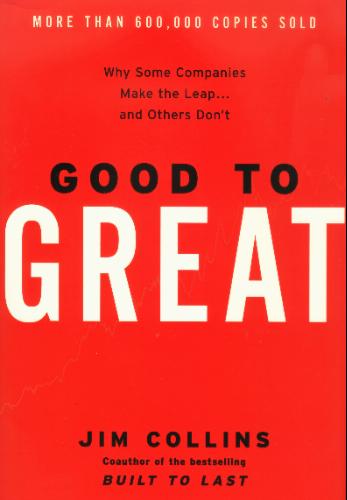
Good to Great by Jim Collins
A must read for anyone desiring to succeed in any area of life. The principles of a Hedghog concept and who is 'on the bus' are extremely powerful. This book is so successful and popular that many of its ideas are now becoming cliche. The author Jim Collins and his staff of researchers really fight hard to come up with concepts from existing successful businesses. They first define meticulously what businesses have gone from 'good' to 'great' then interview their past leaders, employees, read thousands of articles, and more in order to bring a great analysis of what it means to go from good to great. One spoiler you'll read in chapter 1; good is enemy of great...
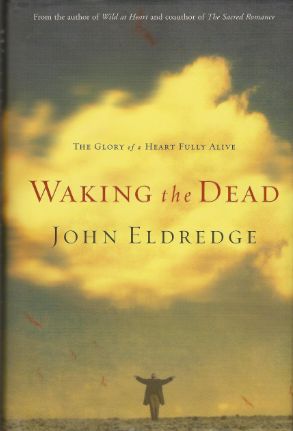
Waking the Dead & Wild at Heart by John Eldredge
I'm covering two books simultaneously in this short review. Ever wondered why your faith seems to be empty in certain areas of life? The book Waking the Dead opens the subject of why we sometimes don't 'feel' our faith, or 'feel' like we are conquering in the name of Jesus. A great book by a great author.
His other book Wild at Heart was an amazing ride through some of the subjects that plague men today; what does it mean to be a man?

Common Sense by Thomas Paine
A great quick read in understanding some of the ideas behind the Constitution and challenging thoughts of their day. Thomas Paine and others like him were much more educated than most who come out of todays educational institutions. They wrote with great understanding, humility, and tact that is lack in our current society. I highly recommend this book for anyone who loves American history or history in general; very enjoyable read.

Yep, this is the book '1984' by George Orwell. He seemed to be a strange fellow and this book pulled out of more of his 'strangeness' than others I think. It was an extremely dark book with a very powerful message though. I do not recommend this one for children. The author writes with extreme honesty in one's mind through the perils of a society controlled by extreme communism. (spoiler alert) He writes to show the basic premise that if the leaders of a society can keep their followers in a crazy cycle (controlled insanity) then the followers will never be able to group themselves long enough to form a revolt. The followers will also be used for the ongoing manufacturing and production for the leaders of that society. Like I said, very dark, very honest, but very probable in how a group of people could be led. He seems to be a slight expert in psychology with some of his major points that he mixes with political science.

Not a short read
Anyone curious about some of the ideas that were floating around in the heads of the political theorists back in the 40s and 50s? This is a great read that captures a lot of those ideas in conversations and shows that our current political ideas are not 'new', but are quite regurgitated. It is a long read, but due to her writing style it goes by fairly quickly. Ayn Rand gets her ideas across through the countless plot lines, which continue to stack as you read. Be prepared to use your brain as you wrestle with the ideas that she brings up through the various plot lines.
Now for some argumentative comments
I absolutely agree with her political theories, but disagree with the humanist view of morality. Just my two cents, but I think that she probably had a lot of contact with more liberal views of Christianity to come to some of her conclusions about 'the mystics' as she calls them. She seems to concrete all of the mystics together as pushing a socialist theme, but does give some subtle hints in the book later of some of the Christians not going for it. Todays more conservative view in Christianity would agree with her 'enjoyment' of life while not asking government to have a greater role in running everything. They (Conservative Christians) would point more to having the responsibility of taking care of others to the church, not the government, who will force their way upon the public once given the power and not give the power back...ever. Either way the book is a very fun adventure that will definitely make you use think twice about what is said and that is always a plus.
A Movie?
Are they going to make an Atlas Shrugged movie? Well, probably not. There will most likely be a TV series spanning all of the stories in the book. This makes the most sense as there is almost 60 hours in the audio book alone. If they even attempted to do a movie they would not be able to capture the main idea of the book very well. I think she kept it long in order to ensure that you saturate the ideas well before you finish the book and move onto something else.
I encourage the reading of the book with one warning that this is not a 'Christian' book by any means and that is alright. Her frozen frame of the society's arguments in her day in comparison with our arguments today will shock you. I'm still stunned to know how much of our political arguments are not new.